I'm pretty unsympathetic to the MacIntyre/Williams criticisms of modern moral theories (I think the Kantian/Korsgaardian has more than enough resources to do justice to ground projects/real human flourishing and I have significant doubts that society suffers at all from leaving behind aretaic theories of virtue) but there is still a lot of value in what Higgins has to say about the struggle to maintain a good, integrated life while participating in the practice of teaching.
In Chapter 8, we finally get to the bottom of what Higgins thinks teaching is all about: reflective questioning. Education, he writes, is "the ongoing conversation taking place in the space opened by the question of what best facilitates human flourishing; it consists of the implicit and explicit answers, described and enacted by those theorists, practitioners, and theorist/practitioners who feel called to join the conversation." (258) All education is necessarily concerned with human flourishing in one form or another, and assumes some account of what human flourishing is. (Also, for the record, don't miss his very insightful account of teachers surrounded by textbooks and tests suffering from "pedagogical Stockholm Syndrome" on p. 256.)
It probably goes without saying that this is a pretty romanticized notion of education.

Showing posts with label Higgins' Good Life of Teaching. Show all posts
Showing posts with label Higgins' Good Life of Teaching. Show all posts
Wednesday, February 22, 2012


Wednesday, February 15, 2012
Higgins' Good Life of Teaching: The Self-abnegating Teacher
In my post I’m going to fast forward to Chapter 5 since
Chapter 4 involves more ground-setting. I am sympathetic to the Taylor/Williams
critique of Morality that Higgins continues to advance in this chapter. With
that critique in hand, Higgins is able to show us that questions surrounding
the aims of education and the practice of teaching become richer topics conceived
of ethically than they are under a narrower conception of morality. However, I
take issue with one of the underlying thesis that Higgins advances in this
chapter. He argues that the focus on morality, to the exclusion of ethics, is
at the core of why teaching is often seen as a helping profession that requires
self-abnegating sacrifice from its practitioners, which leads to teacher
burn-out. It is not obvious that a Kantian line, which seems to be Higgins’
paradigm for a morality focused view, doesn’t have the resources to explain
what has gone wrong in the case of the caricatured burn-out teacher at the
center of this chapter without putting the blame on the teacher’s shoulders.
Monday, February 13, 2012
Higgins' Good Life of Teaching: Arendt's Phenomenology of Practical Life
In this post, I will almost exclusively describe rather than evaluate the content of the chapter, as it primarily is intended to lay the groundwork for a discussion of teaching in a later portion of the book. However, the end result of this discussion for Higgins is that a framework is provided which will help to construct a virtue ethics for the professions, connecting work with fundamental human needs and aspirations, as well as helping us to realize how we are shaped by our work practices.
In contrast to MacIntyre, Hannah Arendt hierarchically divides practical activities into the categories of labour, work, and action. Higgins notes that a discussion of teaching with respect to these categories will be addressed in chapter 7 of the book. In the present chapter, the aim is to reconstruct Arendt's account of seeking flourishing in the practical realm so that we may understand "how the practical life may comprise and compromise our search for a fully human existence" (p. 87). Broadly speaking, Arendt argues that in the past, humans (some, at least) were torn between the contemplative life and the active life, or between vita contemplativa and vita activa . However, human life is now reduced to labour and the scientific/technological pursuits needed to assist labour.
Labour is required because we are embodied beings. Much of what we do to feed ourselves falls in this category. The repetitive cycle of acquiring food, preparing food, eating food, and cleaning up, all done because of our biological need for food, is a clear example of labour. Work includes such things as tool-making, framing a house, designing a house, and building a chair. It is often engaged in to lighten our labour, though it creates more labour in the form of maintaining our homes, tools, and chairs. An architect and a construction worker are both examples of work, for Arendt. Action is an important though difficult concept, as Arendt employs it; it is also the "sine qua non of leading a fully human life" (p.101). In order to clarify this category, Higgins uses "deed", and explains it as something which contains meaning, is in some sense theatrical, and possesses singularity. The examples given are Jackie Robinson's taking the field for the Dodgers on April 15, 1947 and a juror convincing other members that they have overlooked an important piece of evidence. The former communicates without explicit speech, the latter is not mere words but also rectifies a potential injustice. Two general categories of deeds are promising and forgiving. We cannot predict the outcome of deeds in advance, nor can we predict that we will have the opportunity to perform a deed. Lastly, deeds are self-disclosing. They come from who we are, as individuals in a community. And they yield meaning for us and are connected to ends which we pursue for their own sake.
In the last section of the chapter, Higgins explores what all of this has to do with his construction of a eudaimonistic professional ethics. Arendt, however, never gives an example of a job or occupation that falls into the category of action. For her, every activity occurs in only one mode, either labour, or work, or action. Higgins offers two amendments which he takes to strengthen the account (and I agree). First, he states that some activities fall in all 3 of these categories. A chef at an excellent restaurant, will, in her occupation, engage in activities which fall in each of these categories. (This seems to me to be the case with teaching, but we'll see how Higgins deals with this in chapter 7.) The second amendment is that occupational activities are not merely social, they also possess an openness to others. We shape and are shaped by each of these 3 modes of practical life.
I must confess that it isn't entirely clear to me what the full content and significance of this second amendment to Arendt is supposed to be--so any help in the discussion would be much appreciated! Other than that, I look forward to how Higgins will situate teaching within the framework discussed and modified in this chapter of The Good Life of Teaching.
In contrast to MacIntyre, Hannah Arendt hierarchically divides practical activities into the categories of labour, work, and action. Higgins notes that a discussion of teaching with respect to these categories will be addressed in chapter 7 of the book. In the present chapter, the aim is to reconstruct Arendt's account of seeking flourishing in the practical realm so that we may understand "how the practical life may comprise and compromise our search for a fully human existence" (p. 87). Broadly speaking, Arendt argues that in the past, humans (some, at least) were torn between the contemplative life and the active life, or between vita contemplativa and vita activa . However, human life is now reduced to labour and the scientific/technological pursuits needed to assist labour.
Labour is required because we are embodied beings. Much of what we do to feed ourselves falls in this category. The repetitive cycle of acquiring food, preparing food, eating food, and cleaning up, all done because of our biological need for food, is a clear example of labour. Work includes such things as tool-making, framing a house, designing a house, and building a chair. It is often engaged in to lighten our labour, though it creates more labour in the form of maintaining our homes, tools, and chairs. An architect and a construction worker are both examples of work, for Arendt. Action is an important though difficult concept, as Arendt employs it; it is also the "sine qua non of leading a fully human life" (p.101). In order to clarify this category, Higgins uses "deed", and explains it as something which contains meaning, is in some sense theatrical, and possesses singularity. The examples given are Jackie Robinson's taking the field for the Dodgers on April 15, 1947 and a juror convincing other members that they have overlooked an important piece of evidence. The former communicates without explicit speech, the latter is not mere words but also rectifies a potential injustice. Two general categories of deeds are promising and forgiving. We cannot predict the outcome of deeds in advance, nor can we predict that we will have the opportunity to perform a deed. Lastly, deeds are self-disclosing. They come from who we are, as individuals in a community. And they yield meaning for us and are connected to ends which we pursue for their own sake.
In the last section of the chapter, Higgins explores what all of this has to do with his construction of a eudaimonistic professional ethics. Arendt, however, never gives an example of a job or occupation that falls into the category of action. For her, every activity occurs in only one mode, either labour, or work, or action. Higgins offers two amendments which he takes to strengthen the account (and I agree). First, he states that some activities fall in all 3 of these categories. A chef at an excellent restaurant, will, in her occupation, engage in activities which fall in each of these categories. (This seems to me to be the case with teaching, but we'll see how Higgins deals with this in chapter 7.) The second amendment is that occupational activities are not merely social, they also possess an openness to others. We shape and are shaped by each of these 3 modes of practical life.
I must confess that it isn't entirely clear to me what the full content and significance of this second amendment to Arendt is supposed to be--so any help in the discussion would be much appreciated! Other than that, I look forward to how Higgins will situate teaching within the framework discussed and modified in this chapter of The Good Life of Teaching.
Wednesday, February 8, 2012
Higgins The Good Life: Worlds of Practice
In the second chapter Higgins identifies three domains of goods in which virtues are meaningful - moral traditions, individual life narratives, and practices. The web of connections among these give rise to our individual values and meanings. Practices are the main focus here, because his interest is in teaching as a practice, and Higgins distinguishes two sorts of goods internal to a practice. The first can be realized as a community, as when football fans watch an exciting and well played Superbowl. The second can be realized by a particular member of that community, which he refers to as 'internal goods located in the practitioner'. I find the discussion of goods and their interconnection with practices, life narratives, and traditions giving rise to meaning interesting and reflection provoking.
Thursday, February 2, 2012
Higgins' "good life" — and internal and external goods
Thanks to Chris for getting us started with a very lucid account of the overall project of Higgins' book.
Like Jim Spence, I have reservations about the philosophical background that informs Higgins' book: the ancient ethics/modern morality contrast is (I believe) is overdrawn. But rather than be drawn into a discussion of moral philosophy, I'd prefer to focus on Higgins' more immediate project of investigating the goods of teaching.
Figures like Macintyre, Williams, Taylor, etc., get the greatest attention from Higgins, but I think we can all agree that the intellectual progenitor of Higgins' investigation is Aristotle. I understand Higgins' aim as trying to identified the internal goods of the craft of teaching. (Higgins talks of 'practices' rather than crafts, but I'll overlook whatever differences exist between those notions here.) If Aristotle was right and every craft has an internal good (or goods) that define it and at which genuine practitioners of the craft must aim, then it seems reasonable to suppose that teaching, since it seems to be learnable, to involve the development of various human excellences, etc., would also be a craft with its own internal goods.
Like Jim Spence, I have reservations about the philosophical background that informs Higgins' book: the ancient ethics/modern morality contrast is (I believe) is overdrawn. But rather than be drawn into a discussion of moral philosophy, I'd prefer to focus on Higgins' more immediate project of investigating the goods of teaching.
Figures like Macintyre, Williams, Taylor, etc., get the greatest attention from Higgins, but I think we can all agree that the intellectual progenitor of Higgins' investigation is Aristotle. I understand Higgins' aim as trying to identified the internal goods of the craft of teaching. (Higgins talks of 'practices' rather than crafts, but I'll overlook whatever differences exist between those notions here.) If Aristotle was right and every craft has an internal good (or goods) that define it and at which genuine practitioners of the craft must aim, then it seems reasonable to suppose that teaching, since it seems to be learnable, to involve the development of various human excellences, etc., would also be a craft with its own internal goods.
Sunday, January 29, 2012
Higgins, Chapter 1: Work and Flourishing
I should probably start with an admission: so far, Higgins is preaching to the choir in my own case (I’m actually teaching a seminar on Charles Taylor this semester, so I find myself very sympathetic to Higgins’ way of organizing his discussion). Much of what he says resonates with me on a number of levels, particularly theoretically (in terms of ethics in general) and professionally (in terms of teaching). Since it's the first chapter of the book, my aim is not to be critical. Instead, I’ll simply summarize some of the key points of what I see Higgins’ project to be thus far (and it’s a big one) and then at the end of the post I’ll ask a few brief questions to get things started conversationally.
Thursday, January 26, 2012
One last reminder: The Good Life starts January 30
UPDATE: Chris tells me that those with access to library subscriptions to the Wiley Online Library can download the book section by section.
Well, most of us are already enjoying said life, but our online discussion of Chris Higgins' The Good Life of Teaching begins January 30. Here's my earlier introduction.
Added good news: Chris has indicated that though he wants to keep his nose out of our discussions initially, he'll do a guest post (a sort of 'reply to critics') once our discussion ends mid- February.
I hope everyone will buy the book and join the discussion!
Well, most of us are already enjoying said life, but our online discussion of Chris Higgins' The Good Life of Teaching begins January 30. Here's my earlier introduction.
Added good news: Chris has indicated that though he wants to keep his nose out of our discussions initially, he'll do a guest post (a sort of 'reply to critics') once our discussion ends mid- February.
I hope everyone will buy the book and join the discussion!
Monday, January 2, 2012
Reading group: Higgins, The Good Life of Teaching
Happy New Year to our readers and contributors.
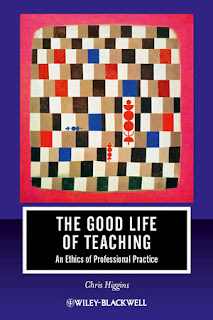 Following our very successful reading groups on Academically Adrift, Not for Profit, and On Course, we are now planning a reading group on Chris Higgins' The Good Life of Teaching.
Higgins' book is more philosophical than the others, promising to offer a conception of the practice of teaching (and of professional ethics in general) that focuses on teachers' self-cultivation. Higgins is particularly interested in how to make sense of teaching as a self-interested endeavor in light of how teaching is often classified as a "helping profession."
So our plan is to being the reading group on January 29. Our contributors will be posting regular entries on the book through the end of February. We hope that everyone will find this group enlightening and join in the discussion.
Buy the book: Wiley, Amazon (including Kindle), BN (including Nook)

Higgins' book is more philosophical than the others, promising to offer a conception of the practice of teaching (and of professional ethics in general) that focuses on teachers' self-cultivation. Higgins is particularly interested in how to make sense of teaching as a self-interested endeavor in light of how teaching is often classified as a "helping profession."
So our plan is to being the reading group on January 29. Our contributors will be posting regular entries on the book through the end of February. We hope that everyone will find this group enlightening and join in the discussion.
Buy the book: Wiley, Amazon (including Kindle), BN (including Nook)
Subscribe to:
Posts (Atom)