
Sunday, April 1, 2012
Delbanco on the future of college
Columbia professor Andrew Delbanco has a new book out, College: What It Was, Is, and Should Be. Based on this interview, it looks worth checking out — mining some of the same themes as Nussbaum's Not for Profit, such as the necessity of liberal arts education to the health of democratic societies, but with a more empirically informed sense of the pressures being exerted on today's colleges.


Wednesday, March 28, 2012
Study strategies revisited
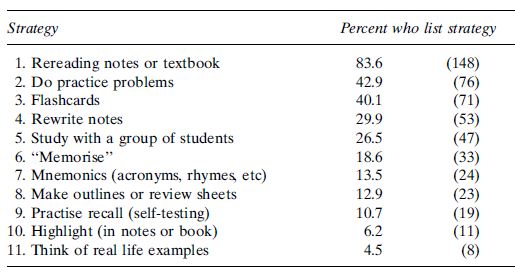
Following up on some past posts about how students study, Daniel Willingham reports on some studies about the frequency with which students use various study techniques (versus how effective those techniques actually are).
Here's a table from a study by Karpicke et al (2009) on the study strategies of students at Washington University:

Here's a table from a study by Karpicke et al (2009) on the study strategies of students at Washington University:
Monday, March 26, 2012
Getting beyond 'learning styles'
We've had some discussions here at ISW about the apparent dubiousness of student 'learning styles' and the notion that instructors should tailor their teaching to these styles. Cedar Reiner and Daniel Willingham do an excellent job separating the wheat from the chaff on this topic — what we can really learn from studies of the diverse ways students learn and what's suspect. They've persuaded me that the learning styles dogma is not only false, but pernicious.
(A quick aside: I strong recommend Willingham's blog on Science and Education — he knows his stuff, inside and out.)
First, a definition of 'learning styles':
(A quick aside: I strong recommend Willingham's blog on Science and Education — he knows his stuff, inside and out.)
First, a definition of 'learning styles':
Wednesday, March 14, 2012
Late to the game: PowerPoint
I know that this makes me a late adopter, but I am
considering using PowerPoint to teach my Intro class next term. I’ve taught
this class a few times and I’m comfortable with the mix of lecturing and
discussion that I have now. I consult my lecture notes sparingly and have a
worked out rhythm that doesn’t require too much preparation on my part. So why
change a good thing? Because I think that it is time to take a new look at how
I’m teaching the course and try something new. As they say, don’t knock it
until you try it. And some students really do seem to think that PowerPoint
would help them learn the material.
Tuesday, March 13, 2012
The Quotable Teacher, installment 17
A teacher who is not dogmatic is simply a teacher who is not teaching.
(G.K. Chesterton)
(G.K. Chesterton)
Women philosophers in social and political philosophy
Our old colleague John Alexander would like some suggestions for readings by women philosophers for a course in social and political philosophy (beyond Warren, Thomson, Nussbaum, Foot, and Gilligan). John is particularly interested in women who write from a rights-oriented approach. Iris Marion Young, Frances Kamm, Onora O'Neill, Susan Okin, and Amy Gutmann come to mind. Any other ideas for John?
Sunday, March 11, 2012
Addressing the pessimistic student objectivist
Reader CD asks in the comments to another post:
I was wondering if we could have a discussion about the following topic (sorry if you have discussed this already). I teach global justice and political philosophy, and the complaint I often hear from students is "well, we agree that X would be fair (X could be something like world equality, the application of Rawls's Difference Principle, or any other moral ideal that students like), but the problem is that it will not happen in real world because agents act according to their self interest and do not care about fairness". Notice that this is different from the typical relativistic objection. They are not saying that there are no objective or universal moral standards. They agree that such standards exist, but believe that it does not make sense to justify them because the world will never be shaped in accordance with them anyway. How should philosophy professors deal with kinds of skeptic objections? Any clue?
Subscribe to:
Posts (Atom)